OTS_SPINS
BY THE ORDER OF THE COMMANDANT OFFICER TRAINING SCHOOL (AFAC)
OTS SPINS
1 December 2025 OFFICER TRAINING SCHOOL (OTS)
Personnel
OFFICER TRAINING SCHOOL SPECIAL INSTRUCTIONS
COMPLIANCE WITH THIS PUBLICATION IS MANDATORY
ACCESSIBILITY: Publications and forms are available on the Officer Training School document management system of record.
RELEASABILITY: This instruction is only releasable through Officer Training School selection processes. Distribution of this publication will be approved by the OPR.
OPR: OTS Operations
Supersedes: OTS SPINS, 18 October 2024
Certified by: OTS Operations (Lt Col Samuel Backes)
Pages: 37
This instruction implements Air Force Policy Directive (AFPD) 36-26, Total Force Development and Management, and Department of the Air Force Manual (DAFMAN) 36-2032, Military Recruiting and Accessions, Air Force Handbook 36-2647, Competency Modeling applies to all Officer Training School (OTS) Officer Trainees (OT) and staff. It provides guidance and standardization for OT training. Refer recommended changes and/or corrections to this publication to the Office of Primary Responsibility using the AF Form 847, Recommendation for Change of Publication, through the chain of command. Subordinate units may publish unit guidance to implement or supplement this manual. Route all implementing or supplementing guidance through OTS Operations prior to approval. Provide a copy of the approved guidance to OTS/A3. Submit waiver requests to OTS Operations through appropriate chain of command. Ensure all records created as a result of processes prescribed in this publication are maintained in accordance with Air Force Instruction 33-322, Records Management and Information Governance Program, and disposed of in accordance with the Air Force Records Disposition Schedule. The use of the name or mark of any specific manufacturer, commercial product, commodity, or service in this publication does not imply endorsement by the Department of the Air Force.
SUMMARY OF CHANGES
Removed OT rank throughout, Replaced Talon with OTS SPINS throughout. (2.4.4.) Greeting of the day is not authorized in the latrine. (2.5.2.1.7.) Added 2 (Two) copies of orders to the mandatory items. (2.6.2.) Added Sim City to the no-salute area. (2.6.3.1.) Added “To The Colors” when rendering customs and courtesies. (2.7.4.5) OTs will sit in the back of the auditorium if they depart. (2.9.4.) Added Form 6. (2.4.5.) Added Form 9. (2.12.1.) Updated WIFI (AWAKEN). (2.14.) Updated OTS alcohol policy. (2.17.1.) Authority to access POC is with ADO. (2.20.) Updated Accessions leave policy. (3.4.) Hydration Pack is optional in the latrine. (4.3.) Updated emergency number. (A2.1.1.) Changed verbiage from “Flight” to “Detail” when giving commands within a SMU. Deleted rank requirement for a SMU. (A2.3.1.) Removed Pennant and added Pennant Test. (A3.6.1.1.) Added the last OT to join the table gives the command to sit. (A5.2.) Removed Flag posted location of practice review stand.
Table of Contents
Chapter 1: OFFICER TRAINING SCHOOL……………………………………………………………………………………. 4
1.1. Officer Training School Ethos…………………………………………………………………………………………………………………. 4
1.2. Officer Training School Vision……………………………………………………………………………………………………………….. 4
1.3. Officer Training School Mission…………………………………………………………………………………………………………….. 4
1.4. Officer Training School Honor Code…………………………………………………………………………………………………….. 4
1.5. Officer Training School Chain of Command……………………………………………………………………………………….. 4
Chapter 2: GENERAL PROCEDURES…………………………………………………………………………………………… 5
2.1. Officer Trainee Designation and Interaction……………………………………………………………………………………….. 5
2.2. Officer Trainee Conduct………………………………………………………………………………………………………………………….. 5
2.3. Scheduled Military Training (SMT)………………………………………………………………………………………………………… 5
2.4. Staff/Officer Trainee Interaction…………………………………………………………………………………………………………….. 5
2.5. Standardization………………………………………………………………………………………………………………………………………… 7
2.6. Customs and Courtesies…………………………………………………………………………………………………………………………. 7
2.7. Academic Buildings Operating Requirements……………………………………………………………………………………. 8
2.8. Reporting Procedures……………………………………………………………………………………………………………………………. 10
2.9. Training Feedback Tools……………………………………………………………………………………………………………………….. 10
2.10. Security Violations……………………………………………………………………………………………………………………………….. 11
2.11. Religious Services………………………………………………………………………………………………………………………………… 11
2.12. Network Access & Computer Usage……………………………………………………………………………………………….. 11
2.13. Food Delivery……………………………………………………………………………………………………………………………………….. 11
2.14. Alcohol Use Policy……………………………………………………………………………………………………………………………….. 11
2.15. Tobacco/Nicotine Product Use Policy………………………………………………………………………………………………. 11
2.16. Authorized Areas and Establishments……………………………………………………………………………………………… 12
2.17. Use of Privately Owned Vehicles (POV)…………………………………………………………………………………………… 12
2.18. Receiving and Entertaining Guests…………………………………………………………………………………………………… 12
2.19. Authorized Travel Areas……………………………………………………………………………………………………………………… 12
2.20. Leave While Attending OTS……………………………………………………………………………………………………………….. 12
2.21. Mobile Phones……………………………………………………………………………………………………………………………………… 12
2.22. Commander’s Review (CR)…………………………………………………………………………………………………………………. 12
Chapter 3: OFFICER TRAINEE DRESS AND APPEARANCE………………………………………………………. 14
3.1. Personal Appearance…………………………………………………………………………………………………………………………….. 14
3.2. Variations…………………………………………………………………………………………………………………………………………………. 14
3.3. Uniform of the Day (UOD)……………………………………………………………………………………………………………………. 14
3.4. Hydration Systems…………………………………………………………………………………………………………………………………. 14
3.5. Reflective Belts……………………………………………………………………………………………………………………………………….. 14
3.6. Eyeglasses……………………………………………………………………………………………………………………………………………….. 14
3.7. Cosmetics………………………………………………………………………………………………………………………………………………… 14
3.8. Items Not Mentioned……………………………………………………………………………………………………………………………. 15
Chapter 4: HEALTH AND PHYSICAL TRAINING……………………………………………………………………….. 16
4.1. Officer Trainee Health……………………………………………………………………………………………………………………………. 16
4.2. Officer Trainee Sick Call………………………………………………………………………………………………………………………… 16
4.3. Emergency Treatment…………………………………………………………………………………………………………………………… 16
4.4. Medical Appointments…………………………………………………………………………………………………………………………. 16
4.5. Quarters…………………………………………………………………………………………………………………………………………………… 16
4.6. Transportation………………………………………………………………………………………………………………………………………… 16
4.7. Medical Profile Documentation and Injury Reports………………………………………………………………………… 16
Attachment 1: GLOSSARY OF REFERENCES AND SUPPORTING INFORMATION……………………………….. 18
Attachment 2: DRILL AND CEREMONIES…………………………………………………………………………………………………… 19
Attachment 3: DINING FACILITY PROCEDURES………………………………………………………………………………………… 25
Attachment 4: OFFICER TRAINEE WING STRUCTURE……………………………………………………………………………… 30
Attachment 5: SAFETY INFORMATION………………………………………………………………………………………………………. 31
Attachment 6: EXAMPLE AETC FORM 341…………………………………………………………………………………………………. 35
Attachment 7: FIELD LEADERSHIP FORMATION………………………………………………………………………………………. 36
Chapter 1: OFFICER TRAINING SCHOOL
1.1. Officer Training School Ethos. As OTS professionals, we are dedicated to owning the mission. We will purposefully develop as leaders within the Profession of Arms with pride, passion, and unity. We will teach and be taught. We will lead and be led. We will identify and push beyond our perceived limits through courage, resiliency, and hardiness of spirit. We will model the way with a relentless pursuit of excellence… “Always with Honor!”
1.2. Officer Training School Vision. The premier leader-development institution within the Profession of Arms.
1.3. Officer Training School Mission. Developing Warrior-Minded Leaders of Character committed to our oath, values, and creed.
1.4. Officer Training School Honor Code. We will not lie, steal, or cheat, nor tolerate among us anyone who does.
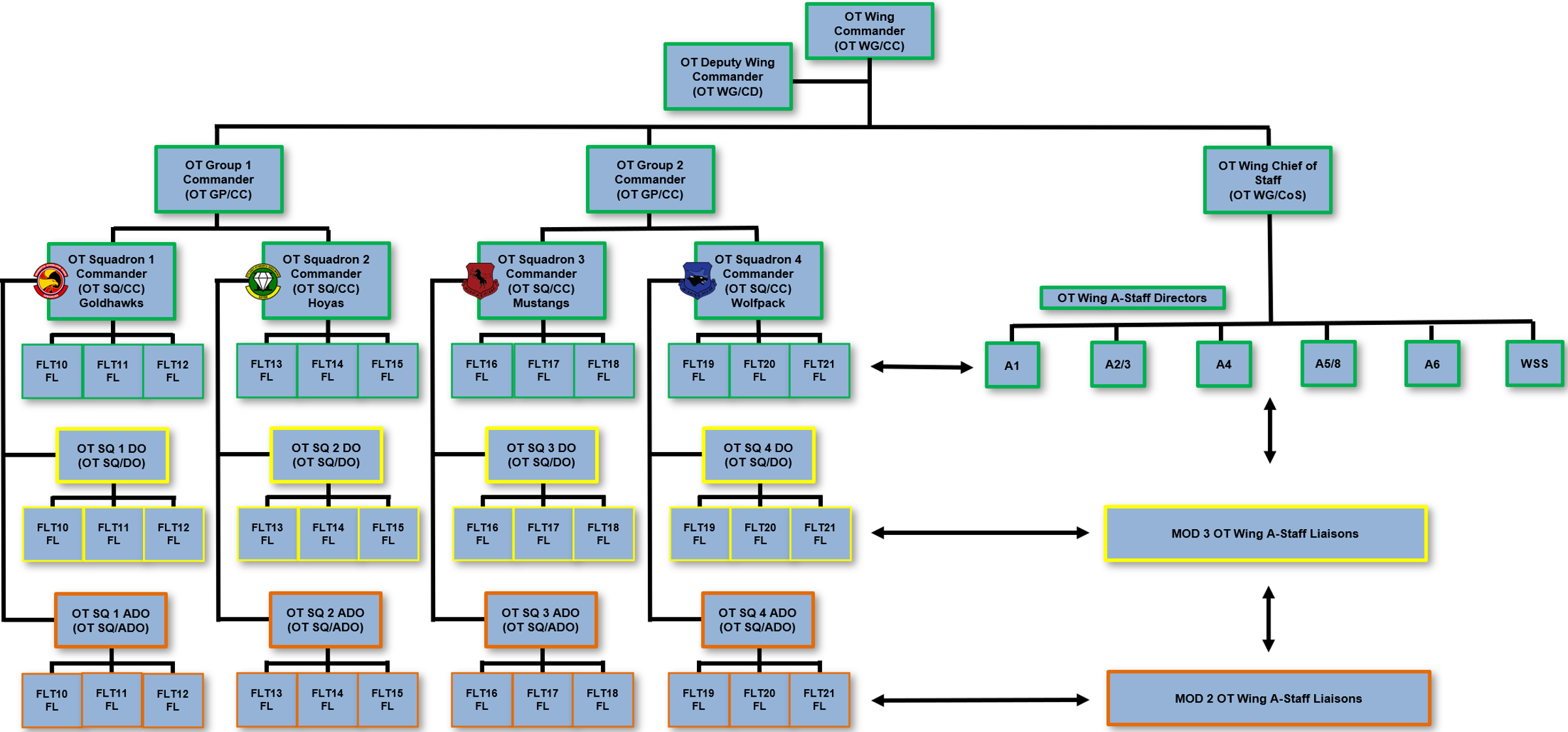
1.5. Officer Training School Chain of Command. See Attachment 4, Officer Trainee Wing Structure. Officer Trainees will enter the Wing upon successful completion of Module 1. Any references to “Squadron” or “SQ” refers to OTS permanent party staff. Any references to “Commander” or “CC” refers to the G-Series permanent party staff commander. Officer Trainee Wing Leadership within the OT Wing will be designated or prefaced by “Officer Trainee” or “OT.”
Chapter 2: GENERAL PROCEDURES
2.1. Officer Trainee Designation and Interaction. References to “Officer Trainee” or “Trainee” in this manual refer to any trainee assigned to OTS. Officer Trainees are addressed as “OT” (e.g., OT Smith or Officer Trainee Smith).
2.2. Officer Trainee Conduct.
2.2.1. Reporting Violations. Officer Trainees will report all violations of the Honor Code and UCMJ to include unprofessional relationships, maltreatment, maltraining, and violations of written or verbal orders. Officer Trainees are required to report any misconduct to their chain of command immediately, whether committed by Officer Trainees, faculty/staff, or others. Failure to report may be punishable under Article 92 of the UCMJ.
2.2.2. AFI 36-2909, Air Force Professional Relationship and Conduct, para 3.1.4. Conduct unbecoming an officer. Officers are accountable for conducting themselves at a higher standard of personal and professional behavior. A failure by an officer to maintain this higher standard, by engaging in an unprofessional relationship, may constitute a violation of Article 133, Uniform Code of Military Justice, Conduct Unbecoming an Officer (10 United States Code Section 933). Article 133 is further defined in the Manual for Courts-Martial.
2.3. Scheduled Military Training (SMT)
SMT is the period beginning with lights-on and ending with the last scheduled training event each day (no earlier than dinner Dining Priority (DP) on weekdays). Missing SMT hours may result in Commander’s Review. After SMT, OTs will need to coordinate any off-campus activity for approval by owning TRS/DO.
2.3.1. Call to Quarters. OTs must be on base by 2100L and signed in with Charge of Quarters (CQ) accountability by 2145L. Trainees will not depart the dormitory until morning accountability is reported and will not depart after evening accountability is reported.
2.3.2. Quiet Hours. Period during which each OT shall have the responsibility to ensure their noise level, whether indoors or outdoors, does not disturb any other OT. Quiet hours are from 2100-2159L.
2.3.3. Lights Out. Period when OTs are in their room sleeping. Taps may be played to initiate lights out, OTs will coordinate with their respective A4 on the playing of Taps. Lights out are from 2200-0430L.
2.3.4. Dormitories. Officer Trainees will not return to the dormitories during SMT unless granted specific permission from OTS Staff.
2.4. Staff/Officer Trainee Interaction.
Officer Trainees will consider all members assigned to OTS as staff regardless of rank or status (to include civilians and guests). Officer Trainees will use “Sir/Ma’am” or rank and last name when addressing staff members or other Officer Trainees. As part of military decorum, Officer Trainees may substitute any verbiage which states “Sir/Ma’am” with rank and last name. For the duration of training, due to positional authority, OTS staff outrank all OTs.
2.4.1. Professional academic environment. Trainees address each other by OT (Last Name). Trainees will address staff by Rank/Last Name or with Sir/Ma’am appropriately. All yes/no responses will be accompanied by Sir/Ma’am.
2.4.2. Addressed by/Addressing Staff Member. When an OT is addressed by a staff member the OT will, in order:
2.4.2.1. Assume the position of attention prior to speaking or when addressed by staff.
2.4.2.2. Respond with 1 of the 7 basic responses.
2.4.2.3. Assume the rest position for the duration of the conversation or when answering a question.
2.4.2.4. When the conversation is over and/or the question has been answered, the OT will assume the position of attention, give the greeting of the day, and salute as appropriate.
2.4.3. When any staff member addresses an Officer Trainee, the Officer Trainee will respond with one of the following seven basic responses, unless otherwise directed. For situations not specified, Officer Trainees will begin or end every sentence with Sir/Ma’am.
2.4.3.1. “Yes, Sir/Ma’am.”
2.4.3.2. “No, Sir/Ma’am.”
2.4.3.3. “Sir/Ma’am, I do not know.”
2.4.3.4. “Sir/Ma’am, I do not understand.”
2.4.3.5. “Sir/Ma’am, may I ask a question?”
2.4.3.6. “Sir/Ma’am, may I make a statement?”
2.4.3.7. “Sir/Ma’am, the answer is.”
2.4.4. Greeting of the Day. Officer Trainees passing OTS staff will give the proper greeting of the day unless the staff member is engaged in a conversation, or in the latrine. Select greeting based on time of day: “Good morning, Sir/Ma’am” from 0000 until 1159L, “Good afternoon, Sir/Ma’am” from 1200 until 1659L, and “Good evening, Sir/Ma’am” from 1700 until 2359L.
2.4.4.1. While indoors, when OTs are in groups of 4 or fewer, all OTs will give the appropriate greeting of the day. If outdoors, all OTs will render salutes as applicable and give the greeting of the day.
2.4.4.2. While indoors, when OTs are in groups of 5 or more, the first OT in line will give the appropriate greeting of the day for the entire group. If outdoors and not in formation, all individuals will render salutes as applicable and give the greeting of the day.
2.4.5. Greeting Order of Precedence. Render the greeting of the day to the highest-ranking individual first when approaching a group (e.g., greet a male Major walking with a female Captain with “Good morning, Sir, Good morning, Ma’am”).
2.4.5.1. If the individuals are of the same rank, greet the female(s) first (e.g., Greet a female Captain walking with a male Captain with “Good morning, Ma’am, Good morning, Sir”).
2.4.5.2. If all individuals are of the same sex, greet them as a group with “Ladies” or “Gentlemen” (e.g., a male Major and Captain will be greeted with “Good morning, Gentlemen”).
2.4.5.3. If rank is indeterminable, greet the female(s) first (e.g., A group of four males and two females in the Physical Training (PT) Uniform greeting is “Good morning, Ladies. Good morning, Gentlemen”).
2.4.5.4. If the Officer Trainee knows the staff member (i.e., the staff member is their Flight Commander or assigned MTI), it is acceptable to greet them by name in rank order. For example, “Good morning, Major Smith; Good morning, Master Sergeant Scarib.”
2.4.6. Delivery of the greeting of the day should sound clear and confident from an appropriate distance.
2.4.7. When entering or departing staff office areas (cube city), OTs will announce their presence by clearly stating “OT(s) in the area” and “OT(s) departing the area.”
2.5. Standardization.
Officer Trainees will always present a standardized and professional image.
2.5.1. Academic Areas/Outdoor Events. Officer Trainees will standardize all equipment/gear to the maximum extent possible to present a neat, orderly, and organized appearance.
2.5.2. Uniforms. Officer Trainees will standardize uniform wear to the maximum extent, while exercising good judgement and appropriate decision making.
2.5.2.1. Mandatory Items. The following items will be carried on the trainee’s person at all times:
2.5.2.1.1. Identification Card. Government issued photo ID (e.g., Common Access Card, Driver’s License, Passport, etc.)
2.5.2.1.2. Hydration System. See para. 3.4. for further hydration system requirements.
2.5.2.1.3. Writing Implement/Material. Pencil or blue or black ink pen, paper to take notes. Exceptions: Not required for PT sessions.
2.5.2.1.4. Two properly filled out copies of the AETC Form 341 IAW Attachment 6.
2.5.2.1.5. Reflective Belt. See Chapter 3 for approved deviations.
2.5.2.1.6. OTS SPINS.
2.5.2.1.7. Two (2) copies of your orders
2.6. Customs and Courtesies.
2.6.1. Saluting. Saluting is taught as a formal lesson by training day (TD) three IAW AFI 1-1, Air Force Standards.
2.6.1.1. Do not salute indoors unless formally reporting-in to a commissioned staff member’s office/cubicle or upon receiving an award at an awards ceremony. Do not salute when reporting to enlisted staff members, except during Open Ranks Inspections.
2.6.1.2. While outdoors, Officer Trainees passing an officer engaged in conversation will render a salute but not interrupt with the greeting of the day. If the officer does not return the salute, Officer Trainees will continue and drop the salute once abreast the officer(s).
2.6.1.3. Saluting is not required when either staff or Officer Trainees are in Physical Training Gear (PTG); however, Officer Trainees will render the proper greeting of the day.
2.6.2. No-Salute Areas. Saluting is not required at any field leadership event to include the following locations: LRC, assault/confidence courses, Blue Thunder, Vigilant Warrior, running track, the covered breezeway between Gilbert Hall/Gilbert Hall Annex, Ritchey Center, Sim City, and Dojo.
2.6.3. “Reveille,” “Retreat,” and “National Anthem” Courtesies.
2.6.3.1. “Reveille and Retreat.” Flags on stationary flag staffs are only saluted during reveille, retreat, or special ceremonies. In these cases, when outside and in uniform, consistent with safety and mission requirements, Airmen stop what they are doing, face the direction of the flag (if visible) or the music. Stand at parade rest during the sounding of retreat or reveille (which precedes the lowering of the flag), then come to attention and salute during the playing of the National Anthem or “To the Colors.” If driving a vehicle, stop if consistent with safety and mission requirements. Airmen and their passengers should sit quietly until the music ends.
2.6.3.2. “The National Anthem.” When “The National Anthem” is played indoors during a ceremony, military members in uniform will assume the position of attention, face the flag, but not salute. If in civilian clothes indoors or outdoors and “The National Anthem” is played, assume the position of attention, and place the right hand over the heart. If wearing a hat, it should be removed. If outdoors, uniformed members will face the flag or music (if flag is not visible) and render a salute upon hearing the first note and hold the salute until the conclusion. Saluting outdoors while in civilian clothes is permitted, but not required.
2.6.3.3. Exceptions. When participating in PT, Leadership Exercises, or Warrior Events, Officer Trainees and staff should continue with these activities and are not required to render normal customs and courtesies for “Reveille,” “Retreat,” or “The National Anthem.”
2.7. Academic Buildings Operating Requirements.
2.7.1. Talking. Talking is not permitted outside of academic building classrooms unless making on-the-spot corrections to other Officer Trainees or giving the greeting of the day. Officer Trainees may talk quietly inside the flight room until the Class/Flight Leader instructs them to prepare for instruction.
2.7.2. Hallways. Officer Trainees will march in a single file, at the position of attention, on the right side of the hallway (to include the Annex breezeway). Officer Trainees will not perform facing movements on carpeted areas.
2.7.3. The Personnel Action Center (PAC) and the Independent Duty Medical Technician (IDMT) Waiting Area. Officer Trainees will remain seated and read OTS SPINS until called for by staff member.
2.7.4. Auditoriums. Officer Trainees will enter the auditorium and fill the seats starting in the front according to the seating arrangement assigned by Officer Trainee leadership. Officer Trainees will remain standing at ease, quiet, and studying OTS SPINS until the lecturer’s instruction to take seats; then sit at ease and remain attentive.
2.7.4.1. Auditorium Opening. The class leader will come to the position of attention, centered in front of the stage, they will then state “STANDBY” to allow for the putting away of all materials to include their OTS SPINS. After this is complete, they will then call the room to attention once they see the instructor approaching.
2.7.4.2. Auditorium Closing. Once the instructor/lecturer indicates they are ready to close class, the class leader will come to the position of attention, march directly to the center in front of the stage and command: “Class, prepare for dismissal.” OTs will then set aside class materials and stand at Parade Rest; the class leader will then call the room to attention. When the instructor/lecturer departs the auditorium, they will command “CARRY ON” and the class will respond with “ALWAYS WITH HONOR.” If the instructor/lecturer does not give the command, the class leader will command “CARRY ON” once the instructor/lecturer has left the auditorium, the class will respond with “ALWAYS WITH HONOR.” After “ALWAYS WITH HONOR,” Officer Trainees will follow staff direction. If there is no direction from the staff, Officer Trainees will prepare for the next lesson by transiting back to their flight room or the designated event location.
2.7.4.3. Asking/Answering Questions. When Officer Trainees wish to ask a question or provide an answer during an auditorium lecture, they will remain seated and raise their hand. Unless directed otherwise, when the lecturer recognizes the Officer Trainee, the Officer Trainee will, in order: stand at attention, provide the greeting of the day, state OT and Last Name, ask or answer the question, and stand at ease until the dialogue is complete or invited to sit.
2.7.4.4. Tardiness. Officer Trainees who arrive late to an auditorium lecture will sit in the back of the auditorium and will not disrupt the lecture.
2.7.4.5. Attendance. Officer Trainees will not leave the auditorium during a lecture except for unforeseen health issues and staff-directed/approved appointments. If an Officer Trainee must leave, they will reenter discreetly and sit in the back of the auditorium. Officer Trainees directed to leave for disrupting the lecture will immediately notify their Flight Commander.
2.7.5. Flight Room.
2.7.5.1. Heads-Up Display. Before each flight room lecture, the Flight Leader will ensure the lesson title (e.g., Followership), instructor’s rank and name, scheduled time (e.g.,1310-1400), and cognitive samples of behavior for that lecture are written neatly and legibly on the left side (as viewed from the back of the room) of the white board.
2.7.5.2. The Flight Leader will sit in the position closest to the white board to easily view the door.
2.7.5.3. All required training materials will be in place and ready for use. At the request of the Flight Commander display provided lesson slides.
2.7.5.4. Opening Procedures. Prior to the instructor entering the flight room, all trainees will be at parade rest, standing behind their chairs, and facing the center of the room. As the instructor crosses the doorway threshold, the Flight Leader will assume the position of attention and call the room to attention. The instructor will command, “TAKE YOUR SEATS” or “SEATS.”
2.7.5.5. Closing Procedures. Once the instructor indicates they are ready to close class, the Flight Leader will immediately stand, push in their chair, assume the position of attention behind their chair, and command “Flight, prepare for dismissal.” Each flight member will then stand, push in their chair, standardize training materials, and assume the position of Parade Rest behind their chair. After the entire flight accomplishes these steps, the Flight Leader will confirm standardization, assume the position of attention, and call the room to attention. As the instructor breaks the threshold of the doorway, the instructor will command “CARRY ON” and the flight will respond with “ALWAYS WITH HONOR.” If the instructor does not give the command, the Flight Leader will command “CARRY ON” once the instructor has left the flight room, and the flight will respond with “ALWAYS WITH HONOR.” The last Officer Trainee departing the room will ensure all audiovisual equipment (except the computer) and lights are off.
2.7.6. Flight Room and Field Event Protocol.
2.7.6.1. If a lecture is actively in session, Officer Trainees will not call the room to attention when the instructor or a visitor (regardless of rank) enters or exits.
2.7.6.2. When a lecture is not in session (including during lesson breaks), Officer Trainees will call the room to attention when a commissioned staff member enters or exits the room, provided there is not already a commissioned staff member in the room of equal or higher rank. As the officer breaks the threshold of the doorway, the first Officer Trainee to see the officer will call the room to attention. Officer Trainees may prepare using the “STANDBY” command.
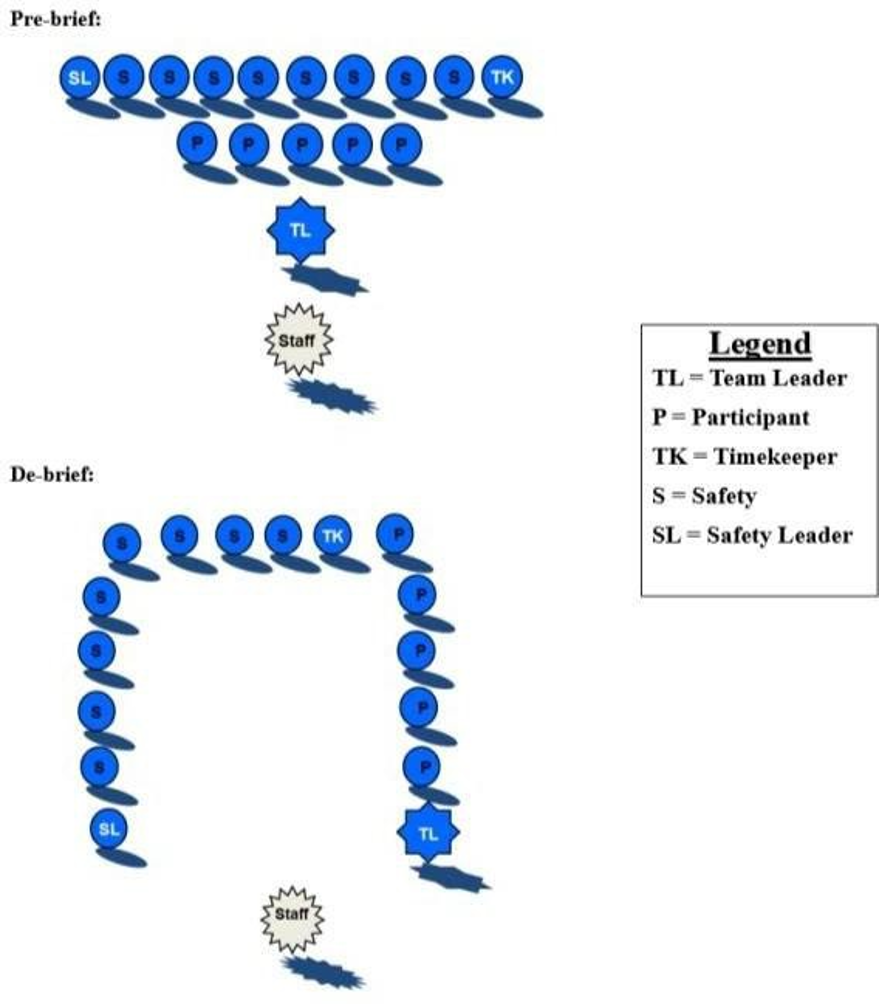
2.7.6.3. Officer Trainees will form up for pre/post event briefs IAW with Attachment 7 for field leadership events (e.g., Leadership Reactionary Course (LRC)).
2.7.7. Use of any OTS conference rooms and non-classroom spaces must be pre-coordinated with owning agency.
2.8. Reporting Procedures.
2.8.1. When directed to report, Officer Trainees will center themselves on the threshold of the door or cubicle entrance and knock once (loud enough to be heard). Once acknowledged, Officer Trainees will enter, using the most direct route to the staff member, center themselves two paces away (if possible) in front of the desk or staff member, salute (if the staff member is a commissioned officer), and give the appropriate reporting statement.
2.8.2. In the office/cubicle area, if multiple Officer Trainees are reporting in, one Officer Trainee in the group will salute (as appropriate) and state, “Sir/Ma’am, (Officer Trainee) (Last Name) plus (number of Officer Trainees) reports as ordered.” If told to take a seat, Officer Trainees will take their seat. When departing, the Officer Trainee who reported-in will salute as appropriate and give the greeting of the day for the entire group. Officer Trainees will take the most direct route out of the office.
2.9. Training Feedback Tools.
2.9.1. AETC Form 341, Excellence/Discrepancy Report. This document may be used to address positive and/or negative Officer Trainee performance. Officer Trainees will always carry a minimum of two copies. The form will have Name, Grade (OT), Organization, and Class/Flight blocks legibly filled in blue or black ink, see Attachment 6 for example.
2.9.2. Motivational Training (MT). MT consists of physical exercises designed to motivate trainees to follow OTS standards and expectations. Qualified staff may administer MT to correct lapses in procedures as well as motivate trainees to work as a team.
2.9.3. Form 2, OTS Leadership Development Report. This form will be used at the discretion of the staff to document performance during leadership activities.
2.9.4. Form 6, Briefing Evaluation Sheet. This form will be used to evaluate briefings.
2.9.5. Form 9, Paper Evaluation Form. This form will be used to evaluate writing assignments.
2.9.6. Memorandums and Record of Individual Counseling (RIC). Memorandums and RICs are a means of documenting Officer Trainee performance expectations. Excessive negative documents affect an Officer Trainee’s ability to successfully complete OTS. Officer Trainees will acknowledge receipt of all memorandums and RICs.
2.9.6.1. Feedback Acknowledgment. If an Officer Trainee wishes to make a response to feedback received during training, they may have up to three duty days from the event to submit a comment written IAW AFH 33-337, Tongue and Quill, to their Flight Commander.
2.10. Security Violations.
Security violations occur when Officer Trainees intentionally or unintentionally permit the release or loss of controlled information, materials, or funds. Examples include leaving dorm room security drawers unlocked when rooms are unoccupied, leaving electronic devices unsecured, leaving Personally Identifiable Information or ID cards unattended, or release of OTS Graded Measures and study materials. Note: Laptops and items stored in backpacks are considered secured when left in an Officer Trainee’s dorm room or flight room provided the system is password or biometrically protected.
2.11. Religious Services.
2.11.1. Officer Trainees may be allotted up to 1 hour to attend worship services of their choice, on Maxwell AFB or virtual services.
2.11.2. The Reflection and Accommodation Center (RAC) is located on the second floor of building 1487 (Room C211) and can be used for personal religious purposes. Officer Trainees will follow all guidance posted inside the RAC concerning its use. Officer Trainees may discuss any issues of religious accommodation in detail with the Holm Center/OTS Chaplain or chain of command.
2.12. Network Access & Computer Usage.
All OTs accessing government information systems are subject to AFI 17-130, Cybersecurity Program Management. Additionally, social media use is subject to AFI 1-1. These provisions are encompassed with in UCMJ Article 92 and violations may be grounds for Commanders Review.
2.12.1. Officer Trainees will complete Department of Defense Information Assurance (IA) Cyber Awareness Challenge training prior to using any computer connected to a .mil network (e.g., requiring CAC access/Air Force network). This requirement does not apply to Officer Trainees using the OTS-provided Wi-Fi network.
2.12.2. Officer Trainees will secure personal, or government furnished, electronic devices. Systems are secured when password protected and may be left in flight or dormitory rooms as training needs dictate. External storage and communication devices must be secured in security drawers when not in use. Devices will be displayed in accordance with dormitory procedures.
2.13. Food Delivery.
Officer Trainees will not order food to be delivered to any location on the OTS campus without TRS SQ/CC approval.
2.14. Alcohol Use Policy.
Officer Trainees are not authorized possession or consumption of alcohol.
2.15. Tobacco/Nicotine Product Use Policy.
Officer Trainees are not authorized possession or consumption of tobacco or nicotine products.
2.16. Authorized Areas and Establishments.
2.16.1. OTS Campus. Includes the Dining Facility (DFAC), academic areas, Physical Conditioning Center (PCC), basketball court, quarter-mile track, drill pad, pull-up bars, and dormitories.
2.16.2. Off Campus. Paperclip running track, volleyball courts, athletic fields, Fairchild Library (academic study purposes only), AU/OTS Shoppette (Express & Military Clothing Sales Store), and any other off campus location to include on-base commercial food vendors requires TRS SQ/CC approval, Module ADO may approve single event usage on a case-by-case basis. Route requests through OT chain of command.
2.16.3. Unauthorized Areas. Officer Trainees will not use, or traverse unescorted, through Ritchey Center (building 1425), including its playground, courtyard, and sidewalks. Staff break rooms are off limits to Officer Trainees. All other locations, including on-base commercial food vendors, require TRS SQ/CC approval, delegated no lower than the TRS SQ/DO.
2.17. Use of Privately Owned Vehicles (POV).
Officer Trainees will only use or access POVs with prior OTS staff coordination and authorization.
2.17.1. Officer Trainees will have until the end of training day two to retrieve all items needed for OTS. After training day two, OTs requiring access will submit an official memorandum to the TRS SQ/ADO.
NOTE: Refer to para 4.6 on for using POVs as medical transport.
2.17.2. Designated Parking Area. Officer Trainees may only use non-reserved parking spaces on Sycamore St., directly north of the paperclip track and grass sports fields, unless otherwise directed. Do not park next to the Ritchey Center.
2.18. Receiving and Entertaining Guests.
Officer Trainees will not entertain guests at the OTS Complex. This includes meeting members on or off Maxwell AFB. Exceptions require TRS SQ/CC approval, route requests through the OT Chain of Command.
2.19. Authorized Travel Areas.
Except for emergency medical issues, travel outside of the local area will not be authorized. Off-base areas and locations will be approved by TRS SQ/CC. Route requests through OT chain of command. While on and off-campus, OTs will travel with a Wingman unless otherwise specified in this manual.
2.20. Leave While Attending OTS.
OTs are not authorized to take leave while in training.
2.21. Mobile Phones.
Cell phone use is limited to official use only during SMT. Phones will be away and silenced during scheduled events, unless required for emergency notification purposes.
2.22. Commander’s Review (CR).
Initiated due to failure of an Officer Trainee’s ability to learn, comply, and/or adapt to the military environment IAW DAFMAN 36-2032, Military Recruiting and Accessions. During CR, all relevant factors will be reviewed by applicable commanders to determine if the Officer Trainee in question will be reinstated, recycled, disenrolled, or disenrolled with prejudice IAW UCMJ, DAFMAN 36-2032, AFI 36-3206, Administrative Discharge Procedures for Commissioned Officers, and/or DAFMAN 36-3208, Administrative Separation of Airmen.
2.22.1. Failure to meet Department of the Air Force standards will result in disenrollment. Officer Trainees may provide a statement after disenrollment proceedings IAW DAFI 36-2907, Adverse Administrative Actions.
2.22.2. The Officer Trainee will be informed of the CR and associated failure and will have three days to submit a rebuttal package with Area Defense Counsel (ADC) for assistance. Rebuttal of failures only applies to CR, see “Feedback Acknowledgement” paragraph for making official statements for received feedback.
Chapter 3: OFFICER TRAINEE DRESS AND APPEARANCE
3.1. Personal Appearance.
Officer Trainees will maintain dress and personal appearance standards IAW DAFI 36-2903, Dress and Personal Appearance of United States Air Force and United States Space Force Personnel, and SPFI 36-2903, Dress and Personal Appearance of Military Personnel, to include any Air Force Accessions Center (AFAC), Maxwell AFB, and OTS Supplements.
3.2. Variations.
3.2.1. Officer Trainees are not authorized to wear the Flight Duty Uniform (FDU), Desert FDU, 2 Piece FDU, OCP baseball cap, or have facial hair, including mustaches, unless approved with waiver.
3.2.2. PTG shirt will be tucked into shorts or running pants while marching, in formation, or while performing group physical training to include formation runs and double-time. Otherwise, PTG shirts may only be untucked during active individual physical training in accordance with DAFI 36-2903.
3.3. Uniform of the Day (UOD).
The training schedule will dictate the UOD and is mandatory for all Officer Trainees. The TRS SQ/DO is the approval authority for all UOD changes and variations. After SMT, with TRS SQ/DO coordination and approval, other authorized uniforms may be worn and shall be worn IAW DAFI 36-2903. Note: Officer Trainees will wear the PTG to sleep unless deviations are approved.
3.4. Hydration Systems.
Hydration systems will be free of patches and will always be worn. While in the dormitories or latrine, hydration system is optional. When worn, everything will be buckled, zipped, or snapped. In the flight room and auditorium, hydration systems will be placed on the back of the Officer Trainee’s chair and standardized. Hydration systems will be hand-carried while wearing service dress or dress blues (Class A / Class B).
3.5. Reflective Belts.
3.5.1. Utility Uniform. Will be worn around waist during hours of darkness and secured around the hydration system during hours of light; may be removed or stowed during the execution of scheduled and independent field events as determined by the TRS SQ/DO. Officer Trainees will maintain standardization of their reflective belts. Exception: will be on person if not taking hydration pack to latrine.
3.5.2. Blues: Class A/Class B. Will be secured around the hydration system.
3.5.3. Officer Trainees will keep their module specific reflective belts in good working order and will not hang items from, or attach items to, the reflective belt.
3.6. Eyeglasses.
Eye-glass straps are required for all field leadership events and PT. Contact lenses are not authorized during field events.
3.7. Cosmetics.
Wear of cosmetics will be IAW DAFI 36-2903. Due to the nature of the training environment, eyelash extensions are not authorized. Cosmetics will not be worn during field conditions.
3.8. Items not mentioned.
Items not mentioned within this document does not mean they are authorized. The philosophy of “It doesn’t say I can’t; therefore, I can” does not apply to this document. If it does not say it is authorized, then it is not authorized.
Chapter 4: HEALTH AND PHYSICAL TRAINING
4.1. Officer Trainee Health.
IDMTs in the OTS Medical Aid Station provide basic medical care for Officer Trainees while at OTS. IDMTs provide Officer Trainee medical profiles and coordinate referrals to the base Medical Treatment Facility (MTF) as needed. Officer Trainees will not seek medical treatment or appointments at the base MTF without first coordinating with the IDMTs or Flight Commander. Officer Trainees with a medical specialty will not self-prescribe medication or provide medical treatment to other Officer Trainees unless life, limb, or permanent sensory impairment is at risk.
NOTE: See Attachment 5 for safety information including Figure A5.2 for fluid replacement in different flag conditions and Figure A5.3 for recognizing heat stress.
4.2. Officer Trainee Sick Call.
Sick call hours will be briefed during medical in-processing. Officer Trainees will notify their instructor of any missed event during SMT due to sick call attendance. Officer Trainees should make every attempt to report to morning sick call. If an Officer Trainee requires any urgent medical care outside of normal IDMT sick call, they should notify their instructor. Medical authorization from the Nurse Advice Line at 1-800-874-2273 is required before any Officer Trainee receives urgent or routine medical care from an off-base provider. Officer Trainees failing to receive authorization prior to receiving off-base urgent or routine care may incur medical expenses. Note: Officer Trainees do not require a wingman for non-emergency IDMT sick call or if referred by IDMTs to Maxwell on-base clinic.
4.3. Emergency Treatment.
If an Officer Trainee requires emergency medical care for a threat to life, limb, or eyesight, call 911 and state you are located on Maxwell AFB and need to be connected to Maxwell AFB emergency dispatch. Officer Trainees will notify the instructor immediately. All Officer Trainees seen off-base for emergency treatment will report to the IDMT the next duty day during morning sick call hours with the off-base medical documentation from their appointment. Upon returning to campus, Officer Trainees will immediately notify their instructor.
4.4. Medical Appointments.
Officer Trainees will notify their instructor and IDMTs of all scheduled appointments and potential impacts to SMT. IDMTs will approve and coordinate all MTF appointments and will track all off-base medical care to include off base surgeries. All Officer Trainees seen off-campus for medical appointments will report to the IDMT the next duty day during sick call hours with the medical documentation from their appointment.
4.5. Quarters.
Officer Trainees placed on quarters by the MTF will notify the IDMTs and their Flight Commander prior to proceeding to their dorm rooms. Officer Trainees placed on quarters by the IDMT will notify their instructor prior to proceeding to their dorm room. While on medical quarters, Officer Trainees will leave their door closed. Flights will coordinate food requirements with the instructor to ensure meal coverage for the Officer Trainee on quarters.
4.6. Transportation.
Transportation to the MTF or to an off-base medical appointment will be by taxi service or, with ADO approval, Trainee POV. Trainees will coordinate with OTS Staff prior to requesting the Base Taxi services. Base Taxi can be contacted at: 334-953-5038.
4.7. Medical Profile Documentation and Injury Reports.
4.7.1. Medical Profiles. If treated at the base MTF, Officer Trainees will present a copy of the AF Form 469, Duty Limiting Condition Report or AF Form 422, Notification of Air Force Member’s Qualification Status, to the IDMTs and their instructor as soon as possible. Officer Trainees seen at an off-base medical facility will present the medical documents from their appointment to the IDMT to establish an AF Form 422. Officer Trainees will present a copy of the AF Form 422 to their instructor as soon as possible. Officer Trainees will always carry the original AF Form 422 with them. Officer Trainees will follow the instructions stated on the AF Form 422 until expired. The “release date” on the AF Form 422 is the date that the Officer Trainee is returned to full duty with no restrictions; release time is lights-on unless otherwise noted. Officer Trainees requiring a medical profile extension will report to the IDMT during sick call. Disregarding the instructions on the AF Form 422 is considered disobeying a direct order and may result in the Officer Trainee being liable for the costs of treating further injuries.
4.7.2. Injury Reports. If injured (either on or off-duty/base), Officer Trainees will notify their instructor immediately, but no later than 24 hours after the injury occurred. Officer Trainees will fill out an AF Form 978, Supervisor’s Mishap Report, and submit the form to their instructor within 48 hours. The AF Form 978 is also required anytime an Officer Trainee is involved in a vehicle accident on or off-base, whether there were injuries or not. The AF Form 978 is not required for Officer Trainees who become ill.
ROXANNE T. TOY, Colonel, USAF
Commandant
Attachment 1: GLOSSARY OF REFERENCES AND SUPPORTING INFORMATION
References
- DODI 1304.33, Protecting Against Inappropriate Relations During Recruiting and Entry Level Training
- DAFI 36-2903, Dress and Appearance of United States Air Force and United States Space Force Personnel
- DAFMAN 36-2905, Air Force Physical Fitness Program
- DAFMAN 36-2032, Military Recruiting and Accessions
- AFPD 36-26, Total Force Development and Management
- AFH 36-2647, Competency Modeling
- AFI 1-1, Air Force Standards
- AFI 17-130, Cybersecurity Program Management
- DAFI 36-3003, Military Leave Program
- DAFPAM 34-1203, Drill and Ceremonies
- AFI 36-2909, Air Force Professional Relationships and Conduct
- AFI 36-2909AETCSUP, _Air Force Professional Relationships and Conduct
- SPFI 36-2903, Dress and Personal Appearance of Military Personnel
- Space Force Handbook 1-1
Adopted Forms
- AF Form 422, Notification of Air Force Member’s Qualification Status
- AF Form 847, Recommendation for Change of Publication
- AF Form 978, Supervisor’s Mishap Report
- AF Form 988, Leave Request/Authorization
- AETC Form 341, Excellence/Discrepancy Report
Abbreviations and Acronyms
DAFMAN—Department of the Air Force Manual AFB—Air Force Base AFI—Air Force Instruction AU—Air University CAC—Common Access Card CC—Commander CQ—Charge of Quarters CR—Commander’s Review DFAC—Dining Facility DO—Director of Operations DP—Dining Priority IAW—In Accordance With IDMT—Independent Duty Medical Technician LRC—Leadership Reaction Course MTF—Medical Treatment Facility MTI—Military Training Instructor OCP—Operational Camouflage Pattern PCC—Physical Conditioning Center PT—Physical Training PTG—Physical Training Gear SMT—Scheduled Military Training TRS—Training Squadron UCMJ—Uniform Code of Military Justice UOD—Uniform of the Day
Attachment 2: DRILL AND CEREMONIES
A2.1. Definitions.
A2.1.1. Small Marching Unit (SMU). Formation of two to four Officer Trainees (Exception: Guidon Bearer may march on their own). In formations with three or four Officer Trainees, the formation is properly sized with the tallest Officer Trainees in the front and on the right. In SMUs of two, the tallest will be to the right. When in an SMU with a guidon, the person on the right will carry it. In SMU formations, all will salute and extend military courtesies as appropriate. SMU’s will use the preparatory command “Detail, ….” OT calling commands will respond to their own commands when in a SMU. Note: Any OT’s performing a specific task (e.g., trash detail, flag detail) will use the preparatory command “Detail, …” If there are 5-7 Officer Trainees, Officer Trainees will make multiple SMU’s. Never make a single SMU greater than 4 Officer Trainees.
A2.1.2. Flight. Formation of eight or more Officer Trainees. This includes a designated Flight Leader and a guidon bearer. There will be at least two but no more than four elements at normal interval. While on the OTS Complex, flights will normally march with two elements. In flight formations, the Flight Leader renders the military courtesies for the formation. Officer Trainees on marching waivers will walk six paces behind the flight and extend all military courtesies themselves.
A2.1.3. Flight Leader. Officer Trainee designated to lead the flight and ensure safety. The Flight Leader ensures all flight members are accounted for. The Flight Leader assumes all responsibility for their flight to include precise flight control through proper command execution and rendering courtesies when appropriate for the flight. After the command of execution has been given and the movement has begun, give other appropriate commands to bring the element to the desired position. If a command is improperly given, the individuals execute the movement to the best of their ability. Flight members will only respond to valid commands.
A2.1.4. Road Guard. Officer Trainee designated to stop traffic while Officer Trainees cross a road or parking lot.
A2.1.5. Element Leader. The leader of the smallest drill unit comprised of at least three, but usually eight to 12 individuals, one of whom is designated the element leader.
A2.1.6. Drill Command. An oral order to direct a formation. Most drill commands consist of two commands. The Preparatory Command, which explains what the movement will be and the Command of Execution, given after the Preparatory Command. This explains when the movement will be carried out. In certain commands, the preparatory command and the command of execution are combined, for example: “FALL IN” or “AT EASE.” Informational commands have no Preparatory Command or Command of Execution, and they are not supplementary. Two examples are “PREPARE FOR INSPECTION” or “COLUMN OF FILES.”
A2.1.7. Cadence. Cadence is the measure or beat of movement. Cadence is given in sets of two as follows: “HUT, TOOP, THREEP, FOURP; HUT, TOOP, THREEP, FOURP.” Do not initiate cadence if a complete set of two cannot be achieved.
A2.1.8. Sizing. OT Flights and OT Squadrons must be sized prior to moving. If not sized, the proper verbiage is as follows: “With the exception of the guidon bearer and element leaders (or with no exception), if you are taller than the Officer Trainee/OT in front of you, tap them on the shoulder and move forward.”
A2.2. General Guidance for Formations
(refer to DAFPAM 34-1203, Drill and Ceremonies)
A2.2.1. The formation leader’s first responsibility is the safety of the formation. Therefore, situational awareness of the surroundings is critical and must be maintained, even when stationary. When giving commands, the formation leader is at the position of attention and in the best position to observe their flight performing the movement. Generally, this will be the action side or direction the flight is moving toward. Good military bearing is necessary for good leadership.
A2.2.2. All Officer Trainees will march at the position of attention while on sidewalks, parking lots, troop walks, across active roadways, and other improved surfaces.
A2.2.3. Double Time. Officer Trainees may double time after 1 hour has elapsed from the last meal. Officer Trainees may double time on paved surfaces to and from physical conditioning activities except when crossing the street. Officer Trainees will not double time during hours of darkness for safety reasons. Exception: Approved formation runs may take place during dawn and dusk, and if the formation is carrying flashlights or reflective gear.
A2.2.4. At Ease March. If using unimproved surfaces (e.g., grass, dirt, etc.) use caution while marching at ease (does not include Welch Field). Extreme weather and flag conditions may warrant marching at ease for long distances. Flights must be placed back at attention while marching prior to giving “Flight, HALT.”
A2.2.5. All members of a formation must carry operable flashlights during hours of darkness and periods of reduced visibility. Exception: Reflective gear is a suitable substitute during formation runs.
A2.2.6. Building Entrance and Departing Procedures| Building entrance procedures. Entrance procedures are necessary to promote good order and discipline among Officer Trainees while entering any permanent structure. These procedures apply to squadron, flight, and SMU formations. If a door becomes propped in the open position, the last Officer Trainee entering will close it.
A2.2.6.1. Column of Files. To form a single file when in a column of two or more elements, the command is: “COLUMN OF FILES from the right (left), forward, MARCH.” If the movement is from the left, on the informational command, the guide will execute a face in marching, then right face in front of the file that will move first and remain at carry guidon. On the preparatory command, the element leader of the right (left) element turns their head 45 degrees to the right (left) and command, “Forward.” The same time, the remaining element leaders turn their heads 45 degrees to the right (left) and command “STAND FAST.” Their heads are kept to the right (left) until they step off. On the command “March,” the extreme right (left) element steps off. The element leader of each remaining element commands “Forward, MARCH” as the last Officer Trainee in each element passes, ensuring the leaders element is in step with the preceding element. All subsequent elements then incline to the right (left), following the leading elements in successive order.
A2.2.6.2. If carrying a guidon, the guidon bearer will place the guidon in the guidon stand (if available). The initial element leader holds the door for the flight. The Flight Leader will hold the door for the initial element leader. The Flight Leader will be the last person from their flight to enter the building.
A2.2.6.3. While marching as an SMU, the Officer Trainee in charge will command, “Flight, HALT, COVER,” followed by the command of “DISMISSED” if entering a building or leaving the general area. “FALL OUT” will be given if remaining in the general area, such as after meals when leaving the DFAC to join the larger flight formation.
A2.2.7. Building departure procedures. The Flight Leader will be the first member of the flight to depart the building and will designate the position for forming the flight. The last Officer Trainee in a formation will ensure building doors close behind them. After open ranks instruction, flights may use the command of “FALL IN.” Flight Leaders will take care to not block traffic into or out of the building.
A2.2.7.1. When departing as an SMU, Officer Trainees will exit the academic building in an orderly manner and form up on the sidewalk. There will be no talking in formation.
A2.2.7.2. Once the flight has been formed, any flight member needing to join the flight will adhere to the following procedures: Salute and state, “Sir/ma’am, (officer trainee) (name), requests permission to join the flight.” The Flight Leader will then return a salute and instruct the Officer Trainee to “FALL IN” or “Size yourself in,” if the formation has been previously sized.
A2.2.7.3. Any individual placed in charge of the flight that is not the designated Flight Leader will return to their position in the flight once control is regained by the designated Flight Leader. To accomplish, the Flight Leader and acting Flight Leader will exchange salutes and the Flight Leader will instruct the acting Flight Leader to “FALL IN” or “Size yourself in,” if the formation has been previously sized. Before a command is given by the regaining Flight Leader, that individual will ensure the flight is aware that they are now in command of the formation.
A2.3. Marching Requirements.
A2.3.1. Pennant. OTS staff will escort flights to all activities that require transit outdoors. Upon passing the pennant test, flights can march without OTS staff direct supervision. Exception: Initial off campus transit must be monitored by staff. Officer Trainees will maintain flight integrity and march as a complete flight as much as possible except when directed by OTS staff, for safety reasons (ref, paragraph A2.6), or in the following cases:
A2.3.1.1. The Officer Trainee senior leadership and designated key staff may march alone and separate from their flights to monitor formation activity.
A2.3.1.2. Officer Trainees may march in pairs to work details.
A2.3.1.3. To meet individual appointments or perform individual PT. (For safety reasons, two or more Officer Trainees must participate in the aerobics/exercise programs together.)
A2.3.2. Officer Trainees are not required to march while escorting guests during authorized times; however, they will maintain a professional military image and render proper military courtesies.
A2.3.3. Formations will be properly sized IAW DAFPAM 34-1203. The Flight Leader will ensure only authorized routes of march are utilized.
A2.3.4. Right of Way for Formations. Under normal conditions, a formation will not pass another formation that is on the march. Formations/SMUs may pass other stationary formations without requesting permission. The leader of a stationary formation must yield the right of way to a formation underway. If formations are on the march and converging on each other, leaders will yield the right of way to formations on their right.
A2.3.5. Utilization of Improved Surfaces Only. Officer Trainees will only plan to march/walk on improved surfaces. Do not walk/march across areas covered in grass surface (unless directed by OTS staff or for safety reasons).
A2.4. Road Guards.
A2.4.1. General Information.
A2.4.1.1. Road guards ensure the safety of Officer Trainees during transit around the OTS campus and Maxwell AFB. Road guards are required for all student formations greater than eight students. For flights seven or smaller, the Flight Leader will function as road guard for their flight. SMUs, formations of two to four students do not require road guards.
A2.4.1.2. The last individual(s) in the rear of each element will serve as a road guard. Required safety equipment for road guards: fluorescent/reflective vest (if transiting off campus), reflective belt, and flashlight (during hours of darkness). Occasionally, situations may warrant more or less than two road guards (e.g., intersections with greater than two possible vehicular traffic routes). Squadron formations require four road guards; they will be positioned in groups of two approximately six paces ahead and behind the formation.
A2.4.1.3. Officer Trainees will not “piggyback” units (march more than one unit across the street without allowing traffic to proceed between them) when crossing streets. OTS staff may do so only when deemed necessary but will make every effort not to obstruct the flow of traffic.
A2.4.1.4. The Flight Leader will render all courtesies for the flight. If an officer (on foot) or staff vehicle passes (from the front) the person in charge will render courtesies. If a staff vehicle approaches the flight while crossing an intersection the road guard will not salute (due to safety). The person in charge will march the flight across the street, halt the flight, call in the road guards, and then render courtesies to the staff vehicle.
A2.4.2. Procedures.
A2.4.2.1. For safety reasons, flights will always be halted prior to entering a hazard area so the Flight Leader can ensure the safety of the posting road guards. Hazard areas include all intersections where vehicular transit occurs including parking lots.
A2.4.2.2. The Flight Leader will move forward, post in front of the flight at the sidewalk or hazard edge.
A2.4.2.3. The Flight Leader will wave traffic past OR motion for the traffic to stop by extending either arm and displaying the palm of the hand with the fingers pointed upward.
A2.4.2.4. The Flight Leader will then march into the intersection and post in the middle of the road, perform an about face (so they are facing the flight), ensure traffic is stopped and command, “Road guards, OUT.”
A2.4.2.5. On the command, “Road guards, OUT,” each road guard will go to the lane as directed by the Flight Leader. They will face oncoming traffic at modified parade rest with the right arm up and palm flat with the fingers pointed upward. If carrying a flashlight, road guards will hold the flashlight in the extended arm with the beam pointed down.
A2.4.2.6. The Flight Leader will command the flight to march across the intersection and perform the necessary facing movements so they can always observe the flight.
A2.4.2.7. Once the flight is through the intersection, the Flight Leader will halt the flight and command, “Road guards, IN.”
A2.4.2.8. The Flight Leader will remain in the intersection and continue to halt existing traffic while the road guards return to the rear of the flight.
A2.4.2.9. The Flight Leader does not give further commands (e.g., “Forward, MARCH”) until rejoining the flight.
A2.4.2.10. Road guards or formation leaders will report vehicles that fail to observe safety precautions or follow road guard directions. Officer Trainees will report the time, place, type of vehicle, license number (if known), and description of the violation to their instructor.
A2.4.2.11. When two or more formations approach opposite ends of a hazard, the formation proceeding to an appointment has priority and the returning formation must yield. The returning formation must move to the side opposite of the hazard and out of the proceeding formation’s path. Once the formation with priority has passed, the returning formation will resume transit on the designated route and execute all road guard procedures as needed.
A2.5. Flight Guidons.
A2.5.1. Flights will carry their flight guidon from start to end of academic day while marching from one location to another on Maxwell AFB, except when specifically instructed by this manual or staff to do otherwise, or due to weather restrictions. Squadron guidons are for official functions only.
A2.5.2. The guidon will be carried to all events except for Blue Thunder and Leadership Reaction Course (LRC), field events held off complex, and PT. If there is no guidon holder at the event, the guidon bearer will make every effort to ensure the guidon is stored/displayed properly and will not become a safety hazard. Guidons will not be posted by jamming them into the ground.
A2.5.3. Storage of the Guidon. Flight Guides are responsible for storing the guidon in the appropriate rack when not in use. Guidons shall not be placed with the tip of the ornament on the ground or with the pennant wrapped tightly around the staff. During any drill class or parade practice, the guidon is placed by the first set of bleachers. If entering a building that does not have a storage rack, Officer Trainees will take the guidon inside with them and place it out of the way, leaning into a corner so that it will not fall. Note: When entering a building with a guidon, Officer Trainees will announce “Guidon” to alert others in the area to the hazard.
A2.5.4. Officer Trainees will take care of the guidon. If any part of the guidon breaks, Officer Trainees will not attempt to repair it, they will take the guidon to the Military Drill and Ceremony (MDC) NCOIC for repair. Officer Trainees will not mark guidons on the staff; marking guidons without pennants will be on the ferrule so to not damage the staff. Once the guidon has a pennant, all additional markings will be removed.
A2.6. Marching Under Weather Conditions.
Officer Trainees and OTS staff are expected to exercise sound judgement and risk management practices while training under adverse weather conditions, regardless of whether an official base notification has been published. During “lightning within five,” Officer Trainees will transit quickly using the most direct route as individuals or in single file. If off campus, seek shelter in a lightning approved location. Lightning approved locations include the Dojo, LRC, and latrines, and the Sim City warehouse. Shelter-in-Place (SIP) only in the event of airborne hazards (e.g., chemical spill) and follow SIP procedures.
Attachment 3: DINING FACILITY PROCEDURES
A3.1. General Information.
Officer Trainees are typically scheduled to eat three meals daily at the Dining Facility (DFAC). Officer Trainees who choose not to eat are still required to process through the DFAC. The menu is available for review prior to entering the serving line and should be used to expedite processing. Use courtesy and etiquette when requesting items from personnel at the serving line. Officer Trainees will make a reasonable attempt to consume all food purchased to minimize food waste. Food will not be taken from the DFAC without prior coordination and staff approval. Extraneous conversation is not authorized in the DFAC.
A3.2. Dining Priorities (DP).
DPs are scheduled times when flights are required to arrive at the DFAC bays. Typically, each flight will be assigned three DPs (breakfast, lunch, dinner) unless the weekly training schedule directs otherwise. Officer Trainees will meet all flight DPs, even those on a weekend/holiday. Note: Officer Trainees performing assigned details during their scheduled DPs are not required to meet their flight’s DP.
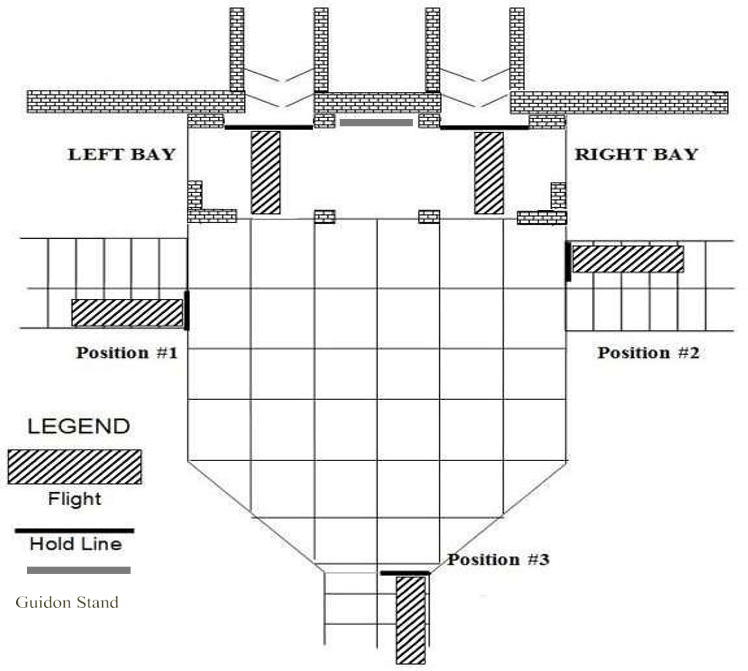 Figure A3.1. Outside Layout of the DFAC.
A3.3. Mess Checker/Chow Shark.
Mess Checkers and Chow Sharks will arrive at the DFAC five (5) minutes prior to the student squadron’s first scheduled DP and will work as a team until the last flight has met their DP. After the last scheduled meal of the day, Mess Checkers will place their DP rosters in their respective CQ binders. Note: Mess Checkers and Chow Sharks will not leave an academic or training session early to perform these assigned duties.
A3.3.1. Mess Checker. The Mess Checker has the authority to clear flights into the DFAC early/late if entry will not inhibit any other flight’s on-time entry. Note: When a Flight Leader is reporting-in to the Mess Checker, neither the Mess Checker nor the Flight Leader will interrupt reporting procedures to greet and salute commissioned staff.
A3.3.2. Chow Shark. The Chow Shark is responsible for ensuring all Officer Trainees follow proper procedures inside the DFAC.
A3.4. Arriving at the DFAC.
Flights will execute ‘Mark Time’ upon arrival at the hold line during DP hours. For extended delays or at the Flight Leader’s discretion, halt the flight. Flights and individual Officer Trainees will arrive no more than plus or minus three (3) minutes of their scheduled DP time. Flight Leaders and individual Officer Trainees will use the time arrived at their initial hold line as their official arrival time.
A3.4.1. Academic Material/Backpacks. Officer Trainees will not bring academic material or backpacks to the DFAC unless directed by OTS staff or during hazardous weather conditions.
A3.4.2. After the hold line, Flight Leaders will march their flight into either unoccupied exterior/overhang.
A3.4.3. Once a flight is in either the right or left exterior bay, the flight will remain at attention, the Flight Leader will take the most direct and unobstructed route to within two paces in front of the Mess Checker, initiate a salute, and state the following: “Sir/Ma’am, flight reports with a dining priority of . We arrived at .” The Mess Checker will return the salute and, if the flight is within their window, allow access once the interior bay is clear. If the flight arrives outside of their window, the Mess Checker will determine if the flight may proceed into the DFAC, wait until their scheduled time, or wait until after the last flight enters. The Flight Leader will give the greeting of the day, return to their flight, and then wait to enter the DFAC. Flights may be “AT EASE” until the inside bay is clear, and they are prepared to enter AFTER they have reported in. Mess Checker will report early/late arrivals, and their resolution, to the OT Wing Commander.
Note: Due to the positional authority of the Mess Checker, the Mess Checker will always drop their salute first.
A3.4.4. Once the assigned interior bay is clear, the Flight Leader will direct their flight to enter using the “COLUMN OF FILES” command. The file closest to the center of the building, enters the DFAC first. After the command, the guidon bearer will place the guidon in the guidon stand and fall-in at the rear of their flight; the Flight Leader will hold open the door and enter last.
A3.4.5. DFAC Arrival During Inclement Weather. Officer Trainees will approach the DFAC entry overhang by the most direct means available. If the interior entry bays are full, flights will march under the overhang, utilizing as much overhang as possible. Up to six flights may seek shelter under the overhang. The PCC is the tertiary hold position during lightning storms if the center of the overhang is full. Once inside, procedures resume as normal starting with the hold line.
A3.5. Serving Area Guidance.
Officer Trainees will perform facing movements and pivots in the DFAC when not carrying food or utensils or on carpeted areas. All movements in the serving line will be accomplished in a modified position of attention.
A3.5.1. Officer Trainees are not required to greet in the DFAC but must still adhere to customs and courtesies. No talking is allowed in the DFAC unless making on-the-spot corrections, issuing required commands, or when directly addressed by OTS and/or DFAC Staff. While moving through the DFAC, Officer Trainees will alert other individuals of their presence and intent to pass by clearly saying, “Sir/Ma’am, excuse me,” “Excuse me, Sir/Ma’am,” or “Pardon me please, Sir/Ma’am.”
A3.5.2. Upon entering the DFAC, Officer Trainees will form two columns beginning abreast the corner edge of the wall and will stand at the position of attention at close interval from each other and from the wall.
A3.5.3. Before moving forward, the Officer Trainee closest to the wall will look both ways to ensure the area is clear to proceed. Once clear, the Officer Trainee closest to the wall will turn their head away from the wall and announce to their wingman, “POST.” The first two Officer Trainees in line will then proceed into the open serving area. Officer Trainees will enter the serving area using either open tray / silverware serving area.
A3.5.4. While transiting to the serving area, the Officer Trainees will fall in file and in-step behind one another, with the Officer Trainee who called “POST” walking in front. Once aligned with the tray and silverware serving area, the Officer Trainees will halt, the Officer Trainee in the back will call “POST” and both Officer Trainees will do a facing movement towards the tray and silverware serving area. The Officer Trainees will take a tray and appropriate silverware ensuring the narrow side of the tray is facing away from them as they continue down the serving line.
A3.5.5. Officer Trainees will sidestep through the entire serving line, keeping their tray on the serving area rails, with 2 hands in contact with the tray at all times. Once at the cashier, Direct Commissioned Officer Trainees must pay for their meal; have form of payment ready for use prior to arrival at the cashier to expedite processing. Line Officer Trainees shall stop and wait for cashier to account for meal items.
A3.5.6. Officer Trainees will not square corners while carrying trays and will only consume food and drink after seated at their table.
A3.6. Dining Area Guidance.
A3.6.1. Seating and table guidance.
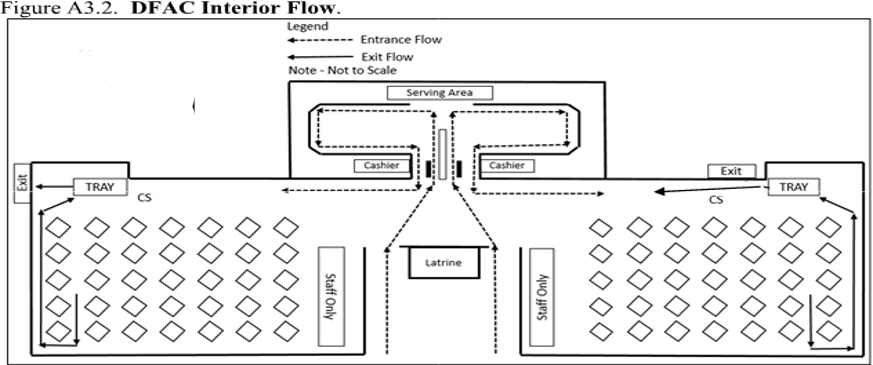
After leaving the service line cashier, Officer Trainees will proceed to the same side seating area. Officer Trainees will quickly fill the farthest row of tables from the serving line first, filling in the furthest open table in the row. Officer Trainees will use the aisle way preceding the table at which they will sit. When filling seats, Officer Trainees will start with farthest open chair., reference Figure A3.2.
A3.6.1.1. Officer Trainees will remain standing at the position of attention behind their chair to be seen by their wingman; once a wingman joins them at the table, they will take their seat. The last trainee to arrive at the table will state “take your seats” and all OTs will be seated. Tables may accommodate up to four Officer Trainees, however, do not join a table which has already sat. Officer Trainees may sit alone at a table provided they wait a reasonable time for a wingman, or as advised by the Chow Shark.
A3.6.1.2. Officer Trainees addressed by a staff member while seated will finish chewing, swallow their food, then respond appropriately.
A3.6.1.3. Officer Trainees will have up to 10 minutes to finish their meals after sitting unless otherwise directed by the TRS SQ/CC.
A3.6.1.4. Officer Trainees may leave their table for additional food or drink. Officer Trainees will push in their chair, come to the position of attention, and proceed to the serving line using the row in which they entered and transit using the outer most rows as depicted in Figure A3.2. Upon returning to the table, Officer Trainees will place food/drink on their tray, come to the position of attention, and then sit down.
A3.6.1.5. When wearing OCPs or PTGs, Officer Trainees may place coats/jackets (if worn) on the back of their chair but will not remove their hydration system. When wearing blues/service uniform, Officer Trainees will place the hydration source on the back of the chair. Officer Trainees will place all other gear neatly under the table, resting on top of their feet, leaning against their shins, with all straps/material stowed away. Once seated, Officer Trainees will bring their chair in as far as possible to avoid congesting the aisle way.
A3.6.2. Clearing the Table.
Officer Trainees are responsible for cleanliness and sanitation of the dining table areas and efficient use of the tray return.
A3.6.2.1. Once finished eating or the time limit has elapsed, whichever occurs first, Officer Trainees will stand, don their gear, standardize, and ground their chairs to the table, assume the position of attention behind their chair, and prepare to depart.
A3.6.2.2. Officer Trainees will stack their trays in pairs of two and wipe down the table, catching crumbs in the trays. Do not place glassware inside of other glassware. Officer Trainees will exit towards the windows, maintaining directional flow of traffic, and transit using the outer most rows as depicted in Figure A3.2.
A3.6.2.3. Place trays in the tray cabinet beginning at the bottom to prevent a top-heavy cabinet. After stowing trays, and ensuring a clean dining area, Officer Trainees will proceed in an orderly manner to the exit.
A3.6.2.4. If receiving a “to-go” meal, Officer Trainees will depart the DFAC, via dining area exit, after cashier transaction.
A3.7. Departing the DFAC.
A3.7.1. Officer Trainees will exit the DFAC utilizing the doors closest to the parade field, unless directed otherwise. Officer Trainees will march alone or in single file to their respective staging area.
A3.7.2. After departing the DFAC, the Guidon Bearer will march to the front of the DFAC to retrieve the guidon and return to their flight, abiding the hold line procedures. Guidon Bearers will not use front/main entrance to retrieve the guidon. Guidon Bearer will not hand carry any items while retrieving guidon.
A3.7.3. Officer Trainees will form up in column formation in the designated area and quietly wait for remaining flight members before forming up as a flight. Once all members are present, the Flight Leader will form and size the flight to march to the next training event.
A3.7.4. Departing During Inclement Weather. When departing the DFAC during lightning storms, OTs will exit the DFAC on the side closest to Welch Field and proceed directly to Gilbert Hall, in a single file, and in an expeditious manner, to gain accountability of flight or as otherwise dictated by OTS Staff / Officer Trainee Chain of Command. Do not collect guidon staffs during lightning within five.
Attachment 4: OFFICER TRAINEE WING STRUCTURE
Attachment 5: SAFETY INFORMATION
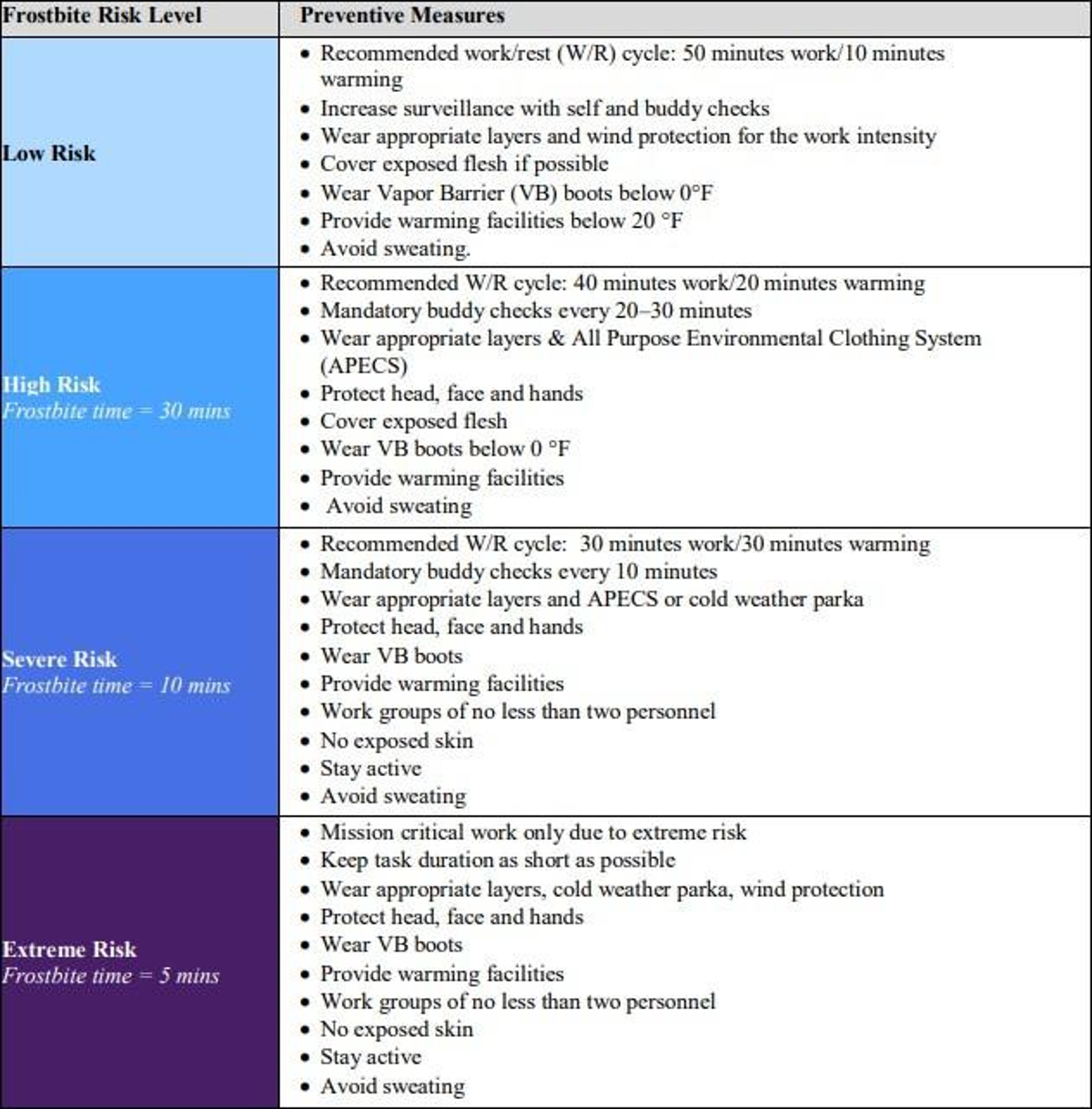
A.5.1. Cold Weather Limitations. Reference DAFMAN 36-2905, Department of the Air Force Physical Fitness Program, for Physical Fitness Assessment limitations. Reference DAFI 48-151, Thermal Stress Program, for physical training, conditioning, and work/rest cycles.
A.5.2. Flag Conditions and Thermal Stress Considerations. Officer Trainees will observe flag conditions and thermal stress considerations throughout the training program, taking appropriate precautions to ensure workloads and hydration schedules are properly being assessed. Flag location is the Dining Facility.
A.5.3. Post Meal Activities. Following a full meal, as defined by Dining Priority, allow for 15 minutes prior to moderate work, 30 minutes prior to heavy work, and 60 minutes prior to very heavy work (ref Table A5.2).
A5.4. Lightning Conditions.
A.5.4.1. Lightning Watch. Potential within in 10 miles. Officer Trainees will march with Guidons.
A.5.4.2. Lightning Warning. Observed within 5 miles. Officer Trainees will seek shelter and remain indoors.
Table A5.1. Work/Rest Times and Fluid Replacement Guide (adapted from DAFI 48-151, Table 3.1.).
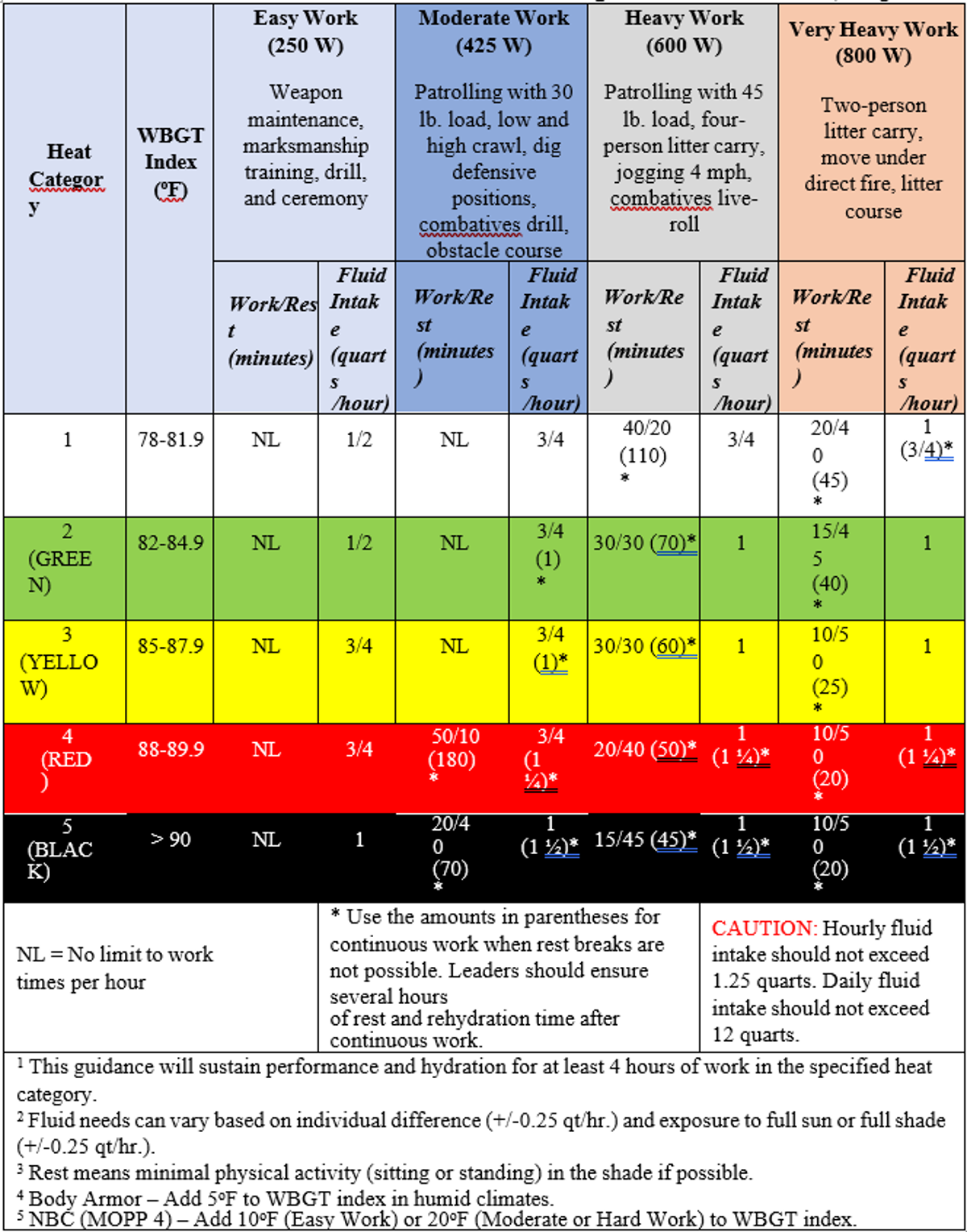
Figure A5.2. Heat Stress Information.
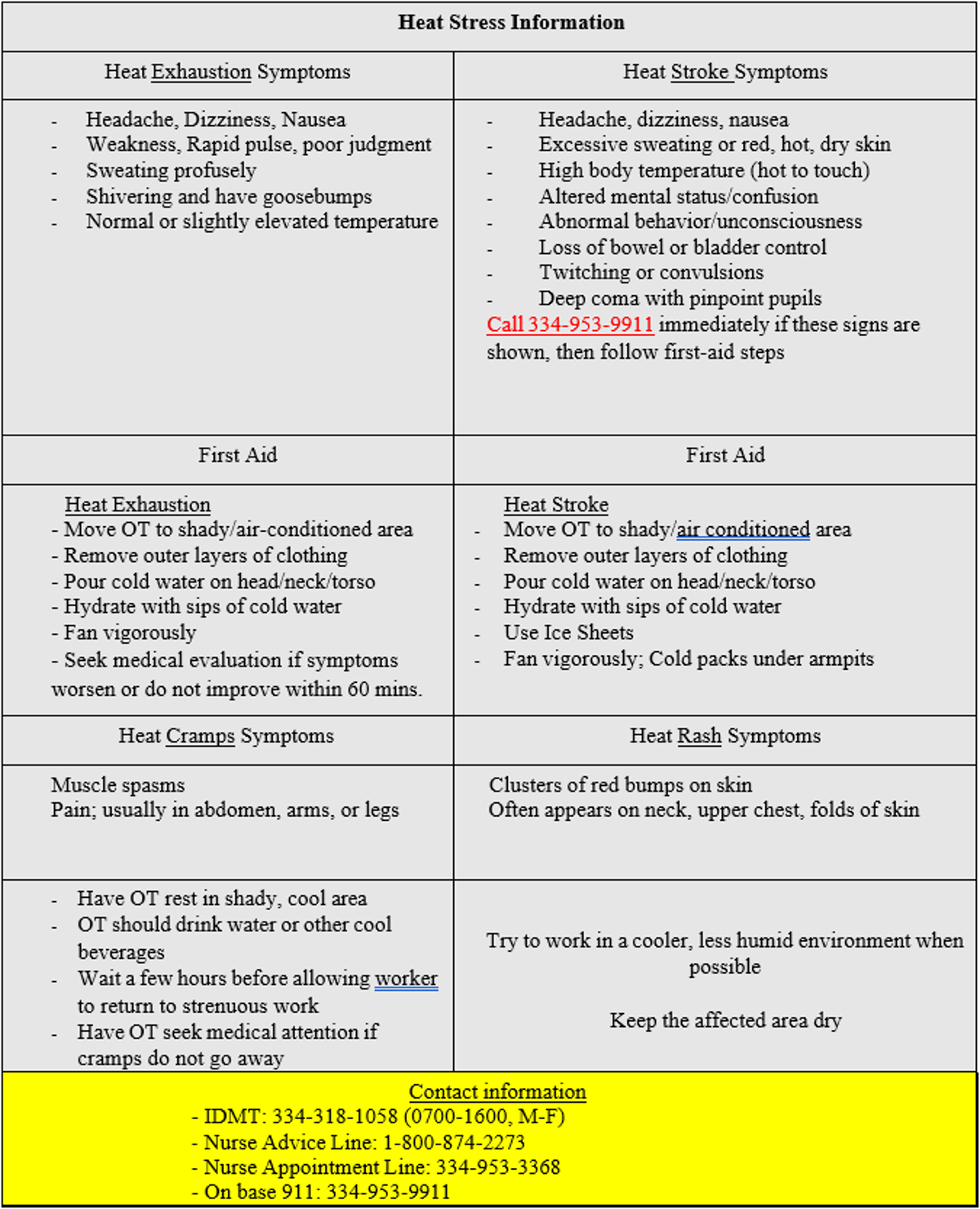
Figure A5.3. Preventative Measures to Reduce Frostbite Risk, Technical Bulletin 508 (US Army, 2005). (DAFI 48-151, Table 5.1.)
Attachment 6: EXAMPLE AETC FORM 341
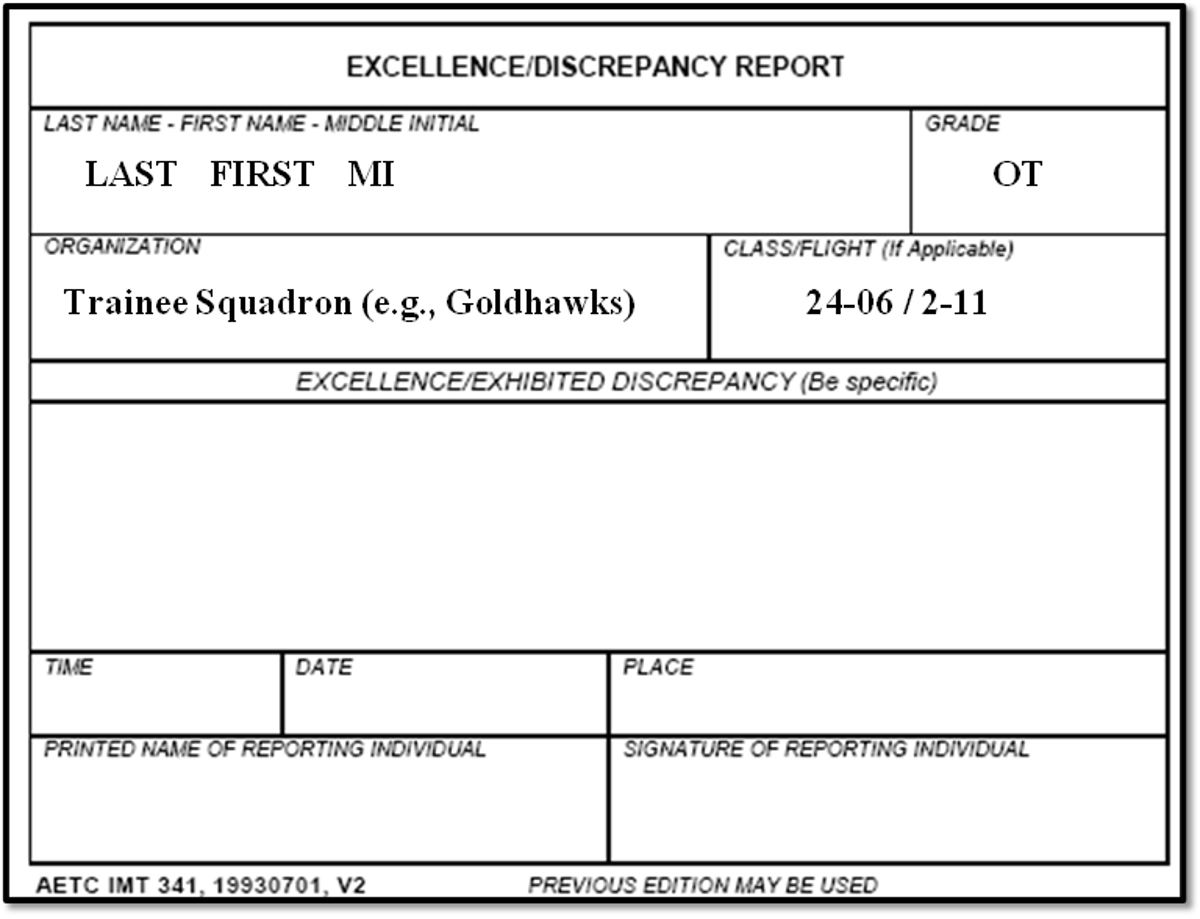
1. Name will be in all caps, LAST NAME, FIRST NAME and MIDDLE INITIAL.
a. No punctuation or dashes in this block.
2. Everyone’s grade will be OT even if direct commissioned.
3. Organization. Will be assigned trainee Squadron (e.g., Goldhawks, Hoyas, Mustangs, Wolfpack).
4. Class/Flight will be IAW registrar.
Attachment 7: FIELD LEADERSHIP FORMATION
ALWAYS WITH HONOR